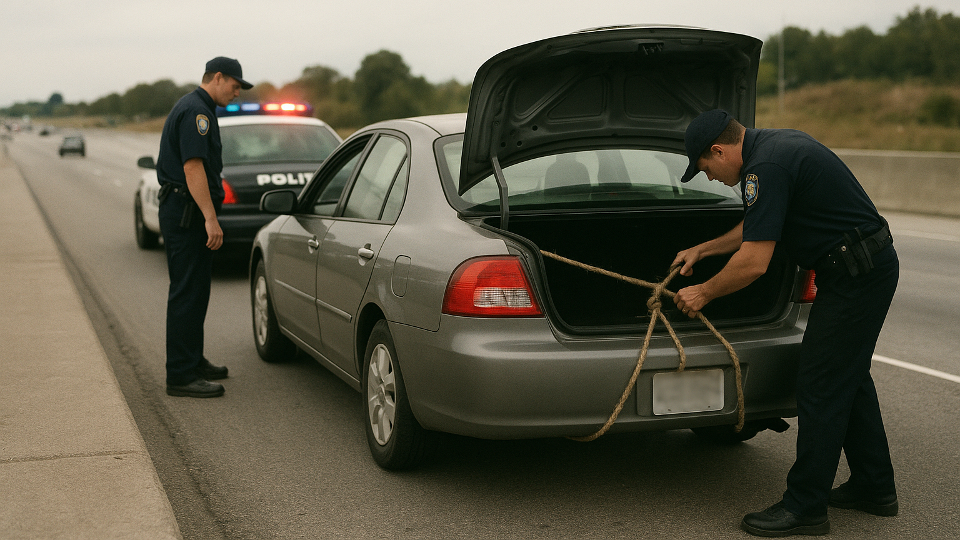
Texas DWI defense often lives or dies at the suppression stage. When officers lack a lawful basis for the initial stop, everything downstream is fruit of the poisonous tree. A recent motion out of Travis County illustrates an underexplored suppression theory: that driving with an open trunk provides no legally cognizable basis for a Terry stop in Texas — and that a failure-to-signal violation observed only after overhead lights were activated is a police-created exigency that cannot cure an unlawful detention.
What Happened
Austin Police officers observed a vehicle traveling northbound on North Lamar with its trunk open and what appeared to be grocery bags inside. Without more, the officers activated their overhead lights. The driver pulled into a gas station. Body camera footage captured the following exchange when a third officer arrived to administer FSTs:
“Why’d you stop him?” “His trunk was open and then he just didn’t use his signal at the last second. Fail to signal 100 feet.”
That exchange — “at the last second,” after the lights were on — becomes the linchpin of two independent suppression arguments.
The Fourth Amendment Requires More Than a Hunch
Under the Fourth Amendment, police cannot detain you without reasonable suspicion — meaning specific, articulable facts that would lead a reasonable officer to conclude that criminal activity has occurred or is about to occur. Derichsweiler v. State, 348 S.W.3d 906 (Tex. Crim. App. 2011)
The key word is articulable. An officer’s hunch, or an honest mistake about what the law actually says, is not enough. Texas courts have made clear that reasonable suspicion must be based on facts known to the officer at the moment the stop begins — not facts discovered afterward, and not a misunderstanding of the law. State v. Duran, 396 S.W.3d 563 (Tex. Crim. App. 2013).
So what does Texas law actually say about open trunks?
What Texas Law Actually Says
The Texas Transportation Code prohibits operating a vehicle that is:
- Unsafe in a way that endangers a person, or
- Equipped in violation of the state’s safety standards.
Neither provision mentions trunks. The state’s vehicle inspection checklist — which covers horns, wipers, mirrors, brakes, tires, lights, and more — contains no requirement that a passenger car have a functional trunk lid or latch.
Compare that to Pennsylvania, where courts have upheld stops for open trunks — because Pennsylvania’s inspection regulations specifically require the trunk lid to be present and to close securely. Texas has no such rule.
The practical upshot: so long as a car with an open trunk isnt endangering anyone, no traffic offense has occurred, and an officer has no legal basis to pull the driver over.
The Failure-to-Signal Problem
After initiating the stop, the officer later offered a second justification: that the driver had failed to signal at least 100 feet before turning. On the surface, that sounds like a legitimate reason.
But here’s the catch — the turn only happened because the officer had already turned on his lights.
Once overhead lights come on, a driver is compelled to pull over. The driver had to turn into the nearest available driveway in response to the officer’s show of authority. Body camera footage captured this exchange between officers at the scene:
“Why’d you stop him?” “His trunk was open and then he just didn’t use his signal at the last second. Fail to signal 100 feet.”
“At the last second” — after the lights were already on. This is precisely what courts call a police-created exigency: officers cannot manufacture the circumstances that give rise to their own authority to act. Bonsignore v. State, 497 S.W.3d 563 (Tex. App.—Fort Worth 2016). The government cannot deliberately create the very conditions it then uses to justify a warrantless stop or search.
An officer who stops a driver on a bad basis cannot save the stop by pointing to a traffic violation that only happened because of the stop.
Practical Takeaways
If you’ve been stopped by police and then charged with DWI or another offense, the legality of the stop itself matters enormously. Evidence obtained as the result of an unlawful stop — field sobriety tests, breathalyzer results, statements — may be suppressible under the exclusionary rule.
Courts do not ask whether the officer was acting in good faith or made an honest mistake. The standard is objective: was there a lawful basis to stop this person at the moment the stop began? If the answer is no, the evidence that flows from the stop may not be used against you.
What to Remember
Police authority to stop motorists is real, but it has limits. Those limits exist for a reason — to protect everyone from arbitrary government intrusion. If you’re pulled over for something that turns out not to be a legal basis for a stop, you may have grounds to challenge the evidence in your case.
If you or someone you know has been charged with DWI or another offense following a traffic stop in Central Texas, contact our office to discuss whether the stop itself was lawful.
David B. Frank is a criminal defense attorney in Austin, Texas, practicing in state and federal court. This post is for general informational purposes and does not constitute legal advice. Every case is different; consult an attorney about your specific situation.



Leave a Reply