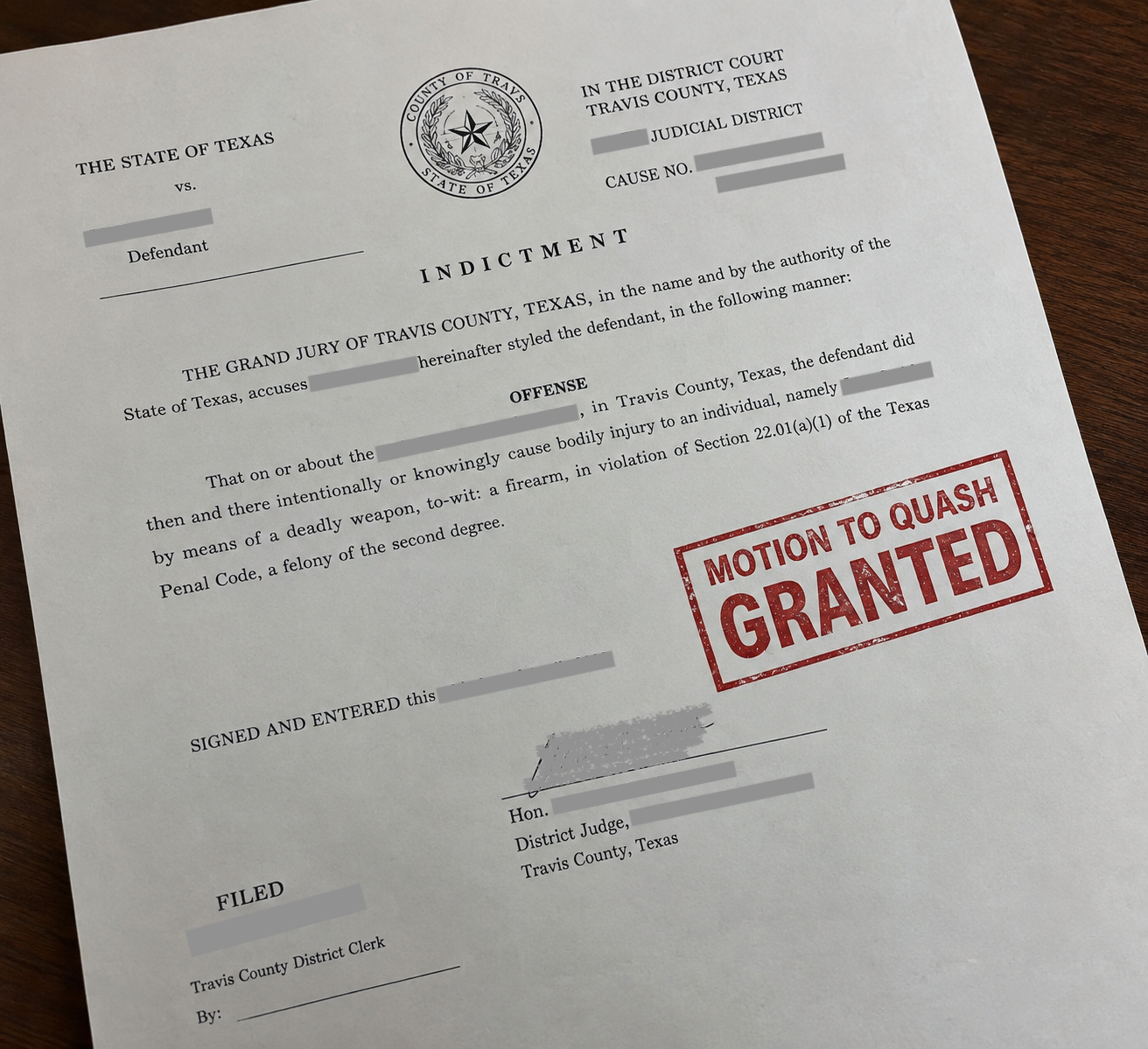
When someone is charged with a crime in Texas, the first question is usually, “What evidence does the State have against me?” That question matters, but it is not the only place you should start. Before looking at the evidence, a careful defense also reads the charging instrument itself.
The charging instrument is the document that formally accuses you of a crime. In felony cases it is usually an indictment returned by a grand jury. In misdemeanor cases, including most first-offense DWIs, it is usually an information filed by the prosecutor. Both must tell you what the State says you did, in enough detail that you can prepare a defense. That notice right comes from the Texas Constitution (art. I, § 10) and the Sixth Amendment, and from the Code of Criminal Procedure (see, e.g., art. 21.11). A defect in the charging instrument can be a problem for the prosecution. A motion to quash is one tool for raising it.
What Is a Motion to Quash?
A motion to quash, which the Code of Criminal Procedure calls an “exception” to the indictment or information, asks the court to find that the charging instrument is legally defective. The Code recognizes two categories of defects.
A motion to quash generally tests what the instrument itself says, not what the evidence will show later. The accused has a right to know against what charges he or she is being called upon to defend.
Timing Matters
A defendant must object to a defect, error, or irregularity of form or substance in an indictment or information before the date trial on the merits begins; otherwise the objection is waived. It generally cannot be raised on appeal either. Motions and exceptions to the charging instrument must be in writing. So the charging instrument should be reviewed early in the case, not after trial has started.
What Happens If the Motion Is Granted?
A client should understand this part. Winning a motion to quash does not usually end the case. If the court sustains an exception, the State can often amend the charging instrument. The State may also re-file or obtain a new indictment. However, sometimes winning a motion to quash leads to a dismissal of the charges.
Even if the motion does not lead to a dismissal, it may still be valuable. It can force the State to commit to a specific theory, expose a real problem such as one involving limitations or jurisdiction, and shape the case going forward. A good lawyer also weighs when raising a curable defect helps the client and when it only prompts the State to fix a problem.
Example: Where the Offense Allegedly Happened
Location is one issue that should be examined, particularly in DWI cases where a driver travels through more than one county.
Venue (the proper county for prosecution) and jurisdiction (the court’s power to hear the case) are different concepts. If the charging instrument recites the correct county, a claim that the offense actually happened elsewhere is a question of fact. It is typically raised through a pretrial challenge or a timely objection at trial, and it can be forfeited if it is not raised in the trial court. Texas law also has special rules for offenses near county lines. For example, article 13.04 allows prosecution in either county for an offense committed on the boundary between counties or within 400 yards of it.
In one DWI case involving a stop near a county line, a comparison of official boundary maps against the State’s allegations led the prosecutor to agree that the offense had not been properly charged in the county where the case was filed. Results depend on the facts of each case.
Prior Convictions and Enhancement
Prior convictions sometimes play a large role in DWI cases, and they can be challenged in different ways depending on how the State uses them.
- When a prior is an element of the offense. In some cases, such as felony DWI, prior convictions are part of what the State must allege and prove. If the indictment does not properly allege a qualifying prior, that is the kind of defect that may be raised by exception before trial.
- When a prior is used only to increase punishment. Challenges to the validity or use of a prior usually happen through objections and proof at trial, not by a motion to quash, because they depend on facts outside the charging instrument.
Two examples of prior-conviction issues:
Out-of-state convictions. Other states define impaired driving differently. You should examine the actual statute under which the prior conviction was obtained, as it read at the time of the conviction, and compare it with Texas’s definition of “intoxicated” and with the current definition of qualifying priors in Penal Code § 49.09. For example, California Vehicle Code § 23152 addresses driving under the influence of alcohol, drugs, or a combination, and other states have different alcohol-concentration thresholds. Courts have addressed whether particular foreign convictions qualify.
Uncounseled convictions. A prior conviction obtained without counsel, and without a valid waiver of the right to counsel, generally cannot be used to prove guilt or enhance punishment.
In Walker v. State, 486 S.W.2d 330 (Tex. Crim. App. 1972), the defendant testified that he had pleaded guilty to two prior DWIs; however, he had not been advised of his right to counsel, could not afford an attorney, and would have retained counsel had he been able to afford one. The evidence did not establish a knowing and intelligent waiver of counsel, and the prior misdemeanor conviction was improperly used at both the guilt stage and for increased punishment.
Always Check the Charging Instrument
A careful early review of the charging instrument asks questions like these:
- Does the instrument allege an offense under Texas law?
- Does it give adequate notice of what the defendant is accused of doing?
- Does it appear on its face that limitations has run, or that the court lacks jurisdiction?
- Was it presented in the proper court and returned by a proper grand jury (where one is required)?
- Where the State relies on prior convictions as elements, are they properly alleged?
Separately, the defense should evaluate, through other motions and objections, whether the offense was committed in the county where it was filed and whether prior convictions are valid and qualify for enhancement.
The State must properly charge a person before it asks a court to convict and punish that person, and a careful defense begins by attacking any defects in the indictment or information.
If you or someone you know has been charged with DWI or another offense in Central Texas, contact our office to discuss whether the charging instrument in your case may be challenged.
David B. Frank is a criminal defense attorney in Austin, Texas, practicing in state and federal court. This post is for general informational purposes and does not constitute legal advice. Every case is different; consult an attorney about your specific situation.



Leave a Reply