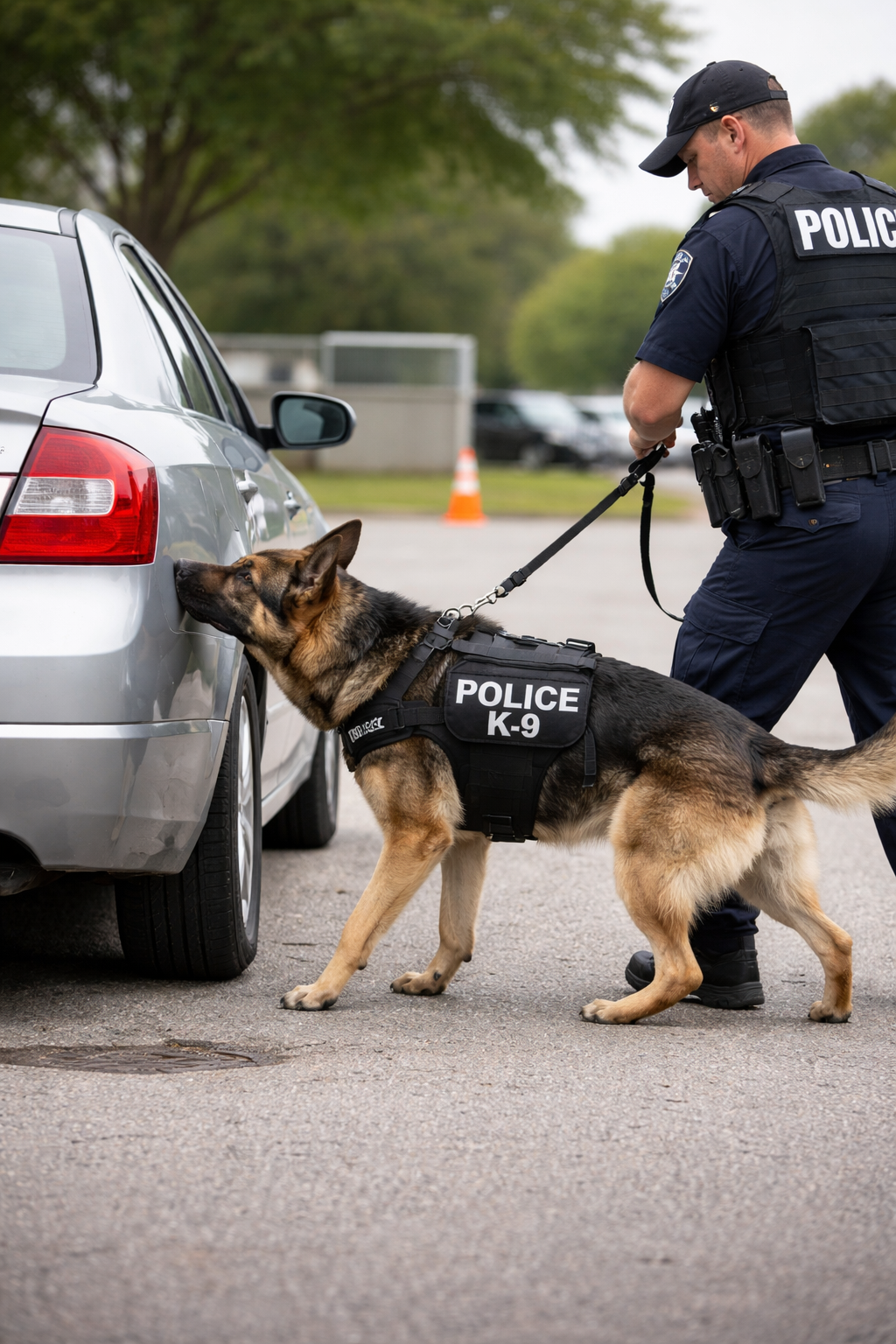
When police unlawfully prolong a traffic stop without reasonable suspicion, the Fourth Amendment is violated. When may evidence be suppressed under Texas and federal law?
Traffic stops are one of the most common encounters between police and citizens, but they are also a frequent source of Fourth Amendment violations. Under both Texas and federal law, a traffic stop that lasts longer than necessary—without reasonable suspicion—becomes unconstitutional. When that happens, any evidence obtained during and after the prolonged detention may be suppressed.
Fourth Amendment Limits on Traffic Stops
The Fourth Amendment protects drivers from being detained longer than necessary to complete the purpose of a traffic stop. Texas courts have consistently recognized that drivers have:
“a reasonable expectation of privacy in not being detained pursuant to a traffic stop for longer than is necessary for the officer to complete his investigation.”
State v. Pettit, 713 S.W.3d 834, 840 (Tex. Crim. App. 2025).
As the Texas Court of Criminal Appeals has explained, the general rule is that:
“An investigative stop can last no longer than necessary to effect the purpose of the stop.”
Kothe v. State, 152 S.W.3d 54, 63–64 (Tex. Crim. App. 2004).
When a Lawful Traffic Stop Becomes Unlawful
A traffic stop that is lawful at its inception can still violate the Fourth Amendment if it is prolonged beyond its lawful scope.
The U.S. Supreme Court made this clear in Terry v. Ohio, holding that a stop may become unconstitutional due to its intolerable intensity or scope.
In the traffic-stop context, this means that once the officer completes the mission of the stop, the detention must end unless there is independent reasonable suspicion of additional criminal activity.
When Does a Traffic Stop End Under Texas Law?
A traffic stop typically ends when the officer has:
- Fully investigated the traffic violation
- Either determined that no violation occurred or issued a citation or warning
Once the traffic violation—and any matters attendant to it—are resolved, continued detention is unlawful without reasonable suspicion. This rule is firmly established in both federal and Texas law. See Rodriguez v. United States, 575 U.S. 348, 350 (2015); Davis v. State, 947 S.W.2d 240, 244 (Tex. Crim. App. 1997).
Prolonged Detention Requires a “Causal Connection”
Courts require a causal connection between the purpose of the initial traffic stop and any continued detention. As the El Paso Court of Appeals has held:
“There must be a causal connection between the initial stop and the further detainment of a motorist.”
Tex. Dep’t of Pub. Safety v. Rodriguez, 953 S.W.2d 362, 364 (Tex.App.—Austin 1997, no writ).
Detaining a driver for reasons unrelated to roadway safety or the original violation—without reasonable suspicion—violates the Fourth Amendment.
Dog Sniffs and Unconstitutional Traffic Stops
One of the most common Fourth Amendment violations occurs when officers extend a traffic stop to conduct a canine sniff.
The Supreme Court has explicitly rejected this practice absent reasonable suspicion:
“Lacking the same close connection to roadway safety as the ordinary inquiries, a dog sniff is not fairly characterized as part of the officer’s traffic mission.”
Rodriguez, 575 U.S. at 356.
When a stop is prolonged to conduct a dog sniff without reasonable suspicion, any resulting evidence is subject to suppression.
What Police May Lawfully Do During a Traffic Stop
During a valid traffic stop, an officer may request:
- A driver’s license
- Vehicle registration
- Proof of insurance
- Ownership information
- The driver’s destination
- The purpose of the trip
The officer may also conduct a computer check and may question passengers with their consent.
When the Officer Must Let the Driver Leave
It is at this point that, unless there is another proper basis for the investigatory detention, the detention must end and the driver must be permitted to leave.
Any continued detention without reasonable suspicion violates the Fourth Amendment and provides strong grounds for suppressing evidence obtained during the prolonged traffic stop.
If police extend a traffic stop after its lawful purpose has been completed—whether to ask unrelated questions, wait for a K-9 unit, or conduct additional investigation—courts may suppress all evidence obtained as a result of that unlawful detention.




Leave a Reply